
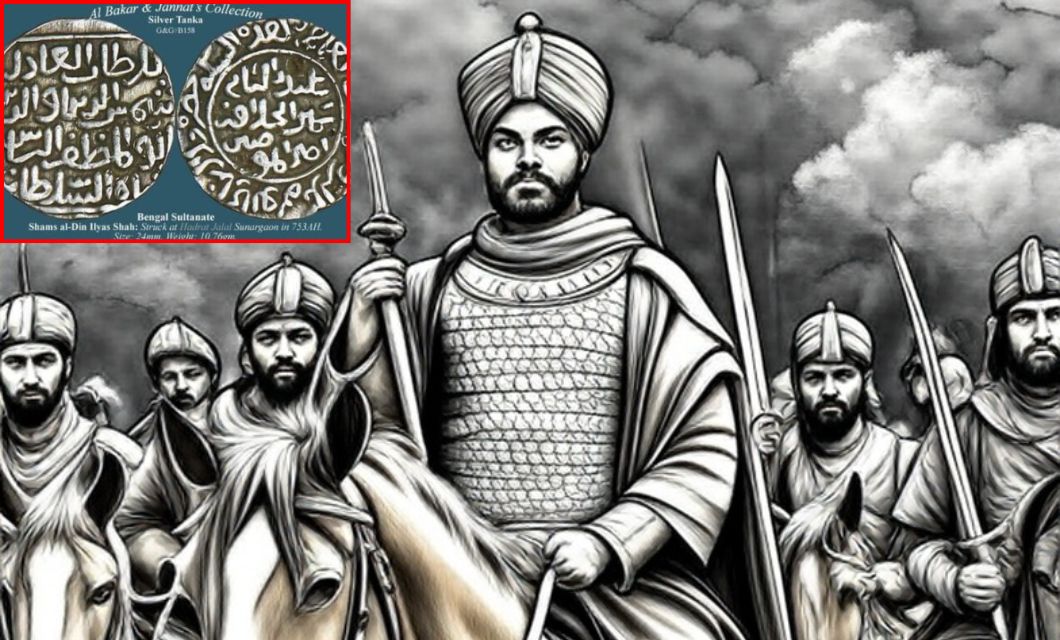
He is celebrated in textbooks as the “founder of the independent Bengal Sultanate” and the man who first called this land “Bangalah” and its people “Bangali.” The truth, stripped of romantic varnish, is far more brutal: Shams al-Din Ilyas Shah (r. 1342–1358) was medieval Bengal’s most ruthless conqueror—a serial invader, temple razer, and plunderer-in-chief who built the foundations of Bengal’s sovereignty on mountains of corpses and rivers of loot.
Born in Sistan (eastern Persia) into a noble family, Ilyas Shah began his career as a common mercenary in the service of Delhi’s Tughlaq governor Malik Firuz. After committing an unspecified but serious crime in Delhi, he fled east and took refuge in Satgaon (present-day Hooghly). There, under the local Tughlaq governor Izzuddin Yahya, he rose rapidly through sheer ability until he became a malik (nobleman). When his master died in 1338, Ilyas simply seized Satgaon by force.

Four years of savage civil war followed. In 1342, he crushed Alauddin Ali Shah of Lakhnauti in a decisive battle so bloody that the chronicles refuse to give casualty figures. Declaring himself Sultan Shams al-Din Ilyas Shah, he sat on the throne of Lakhnauti and immediately turned Bengal into a war machine.
What followed was sixteen years of almost non-stop aggression:
– 1344: Easy conquest of Tirhut (north Bihar).
– 1350: First-ever Muslim invasion of Nepal. Ilyas marched all the way to Kathmandu Valley, sacked the sacred Swayambhunath stupa, looted its gold and jewels, and returned without annexing an inch—pure plunder.
– 1352: Marched east, defeated Ikhtiyaruddin Ghazi Shah, and annexed Sonargaon, finally uniting Satgaon, Lakhnauti and Sonargaon under one sword.
– 1353–54: Invasion of Orissa (Jajnagar). His army swept through Cuttack to Chilika Lake, demolished countless temples, and carried off 44 war elephants and wagonloads of gold and silver.
– 1353–57: Successive campaigns into Bihar, Champaran, Gorakhpur, and as far as Banaras (Varanasi), extending Bengal’s terror frontier deep into northern India.
– 1357: Final triumph—a lightning campaign that overran parts of Kamrup (Assam).
Even Delhi’s mighty Sultan Firuz Shah Tughlaq marched against him with the full imperial army—and failed. After a humiliating stalemate, Firuz was forced to recognise Ilyas as an independent sovereign of Bengal (1353–54). Gifts, ambassadors, and letters flowed between the two courts for the rest of Ilyas’s life—the ultimate diplomatic seal on conquest won by the sword.

Yet Ilyas was no mere barbarian. He understood that an empire built only on terror would not last. He:
– Recruited local Bengalis (Hindus and Muslims alike) into his army in unprecedented numbers—the birth of a truly “Bangali” fighting force.
– Granted land, stipends, and honours to Sufi dervishes and Hindu sadhus alike.
– Founded the city of Hajipur and built luxurious Persian-style bathhouses.
– Most importantly, he gave the land and its people a new identity: Bangalah and Bangali.
When he died in 1358 after sixteen years of almost unbroken war, he left behind a Bengal that was larger, richer, more united—and far more traumatised—than anything it had known before.
History prefers to remember him as the architect of Bengal’s independence and the first nation-builder who dared call us “Bangali.”
The temples he burned, the cities he sacked, and the tens of thousands he slaughtered are quietly forgotten.
Shams al-Din Ilyas Shah was not a saintly unifier. He was a brilliant, pious, tolerant-in-victory—and utterly merciless—warmonger who carved a nation out of other people’s ruins.
And on that mountain of ruins, Bengal’s sovereign history still stands.
 English
  বাংলা
বাংলা
Leave a Reply
You must be logged in to post a comment.